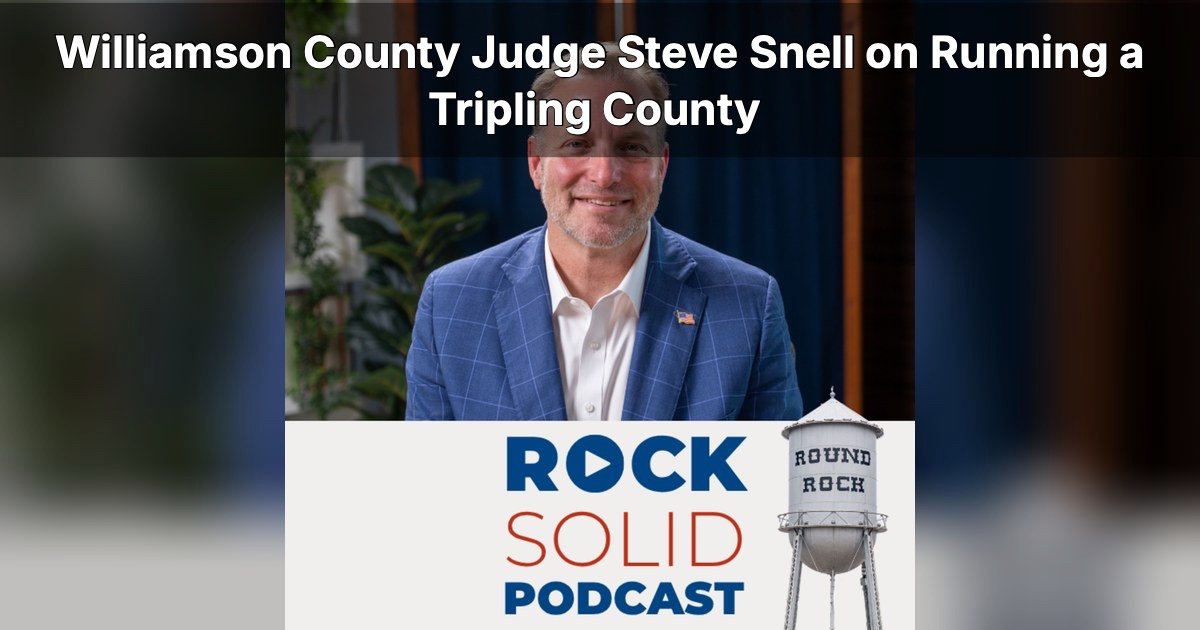
Williamson County, Texas, is on a trajectory to double its population from roughly 760,000 today to 1.6 million by 2055 and 3 million by the end of the century. Managing that explosive growth falls largely to County Judge Steve Snell, who recently sat down with Bryan Eisenberg on the Rock Solid: Round Rock Business Leaders Podcast to discuss the challenges and opportunities ahead. The conversation, published September 15, 2026, offers a rare look inside the office of one of the busiest county executives in Texas.
Snell explains that the role of a county judge is less about presiding over a courtroom and more akin to being a CEO and emergency manager. With oversight of roughly 30 to 35 departments—from fleet services and animal shelters to the juvenile justice center and the Sheriff's Office—he compares the job to running a complex organization. Drawing on 31 years in public education, including leadership roles in Hutto ISD and as superintendent of Liberty Hill ISD, Snell brings a methodical approach to governance. He even arrived at the interview with a three-ring binder tabbed with budget lines, policies, and responsibilities, a habit he credits to his educator background.
The interview covers a wide range of issues, including emergency response after Williamson County's historic July floods and lessons observed from Kerr County. Snell also highlights economic development wins tied to major employers such as Dell, Samsung, Compal, Apple, Firefly, Kalahari, Nebraska Furniture Mart, and the incoming Scheels in Cedar Park. These investments are reshaping the county's tax base and job market, but they also strain infrastructure. On the growth challenge facing unincorporated neighborhoods and Municipal Utility Districts, Snell tells Eisenberg: "When you build 1,000 homes next to an old two-lane road and all the construction trucks tear it up, we need to come and fix that for mobility and safety, or we need to expand it."
Looking ahead, Snell points to the county's designation as a spaceport in partnership with the City of Cedar Park, its geographic position between Fort Hood and joint commands in downtown Austin, and Firefly Aerospace as the anchor of a rapidly expanding space sector. He and Eisenberg also discuss trade education, workforce development, veteran employment as service members transition out of Fort Hood, and entrepreneurship classes in Liberty Hill high schools, where a chamber president now teaches students. Snell praises Round Rock ISD, Leander ISD, Cedar Park's Plug and Play, and partnerships with Precinct 2 Commissioner Cynthia Long on land acquisitions for future schools and parkland.
The implications of this conversation extend beyond Williamson County. As one of the fastest-growing regions in the United States, how local leaders manage transportation, water, energy, and education will serve as a template for other communities facing similar pressures. Snell's emphasis on service—"at the end of the day, it's not about me. It's about service and it's about Williamson County"—underscores a leadership philosophy that prioritizes long-term planning over short-term fixes. With the county's population projected to triple by 2100, the decisions made today will determine whether Williamson County remains a desirable place to live and work or becomes a cautionary tale of unchecked growth.