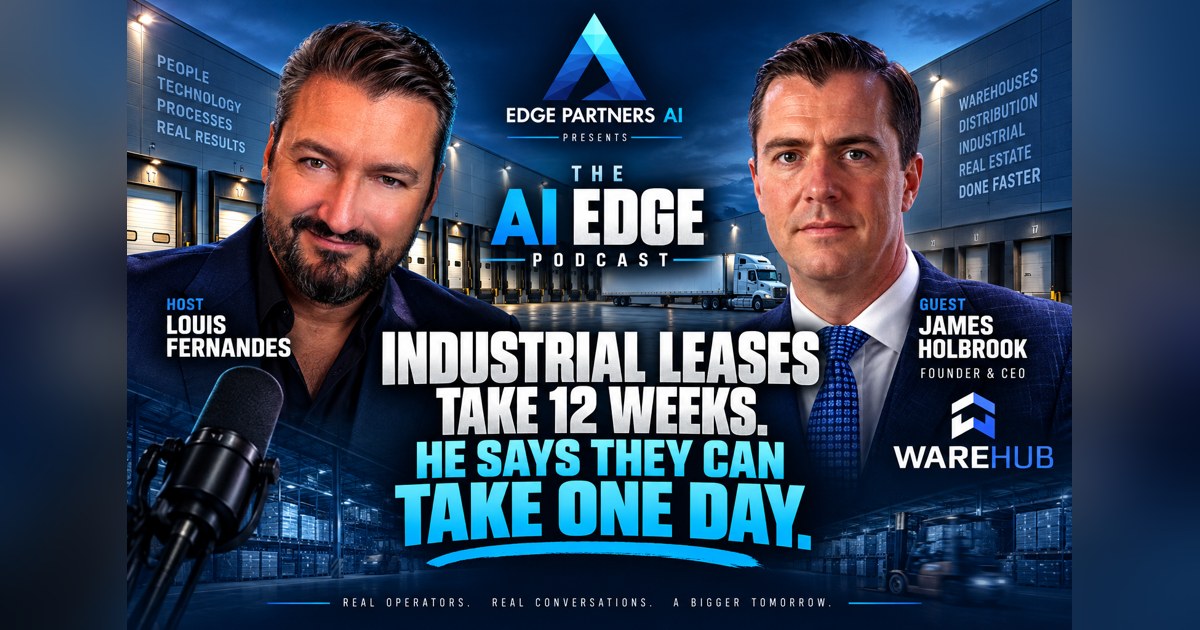
James Holbrook, Founder and Executive Chairman of Warehub, was the featured guest on The AI Edge Podcast: CRE & AI, hosted by Louis Fernandes. The episode, released as part of Warehub's ongoing effort to position itself as the operating system for industrial real estate, delved into how two decades of experience in the sector led to the creation of a platform designed to digitize and standardize leasing workflows.
Holbrook's background includes more than 20 years in industrial real estate and approximately 2,500 short-term lease transactions. That volume of deals exposed him to recurring inefficiencies—manual data entry, fragmented communication, and slow payment cycles—that plague brokers, landlords, and tenants alike. Rather than accepting these frictions as inevitable, Holbrook founded Warehub to address them head-on. The platform connects demand, inventory, and execution through a single intelligent system, enabling users to move from requirement to occupancy with greater speed and transparency.
A critical distinction emphasized during the podcast is that Warehub is not intended to replace or circumvent brokers. Instead, it aims to give them better tools to serve clients and demonstrate even greater value. This broker-centric approach is notable at a time when many proptech solutions are perceived as disintermediating traditional players. By standardizing property data and coordinating the various participants needed to activate industrial space, Warehub seeks to reduce friction without removing the human expertise that brokers provide. The full announcement, including downloadable images and bios, can be accessed by clicking here.
The implications of this announcement extend beyond a single podcast episode. Industrial real estate has lagged other asset classes in digital transformation, with many processes still reliant on spreadsheets and email chains. Warehub's proposition—standardized data, digitized leasing, and coordinated execution—could become a blueprint for how the sector operates. If successful, it may accelerate deal cycles, reduce errors, and improve payment speed, as suggested by the company's tagline: "More deals. Less friction. Faster payment." For brokers, the promise is not replacement but augmentation, allowing them to focus on relationships and strategy while the platform handles routine tasks.
Moreover, the podcast serves as a signal that AI is moving from hype to practical application in commercial real estate. Holbrook's discussion of how transaction friction became the foundation for Warehub illustrates a bottom-up, problem-driven approach to innovation. As the industry faces pressure to do more with less, tools that streamline operations and enhance client service will likely gain traction. Warehub's emphasis on connectivity and intelligence could help it stand out in a crowded proptech landscape.
For those interested in learning more, additional details are available at warehub.com. The podcast episode itself offers a case study in how domain expertise can translate into technological solutions that benefit an entire ecosystem. As industrial real estate continues to evolve, Warehub's broker-friendly model may well become a standard for how technology and human expertise coexist.