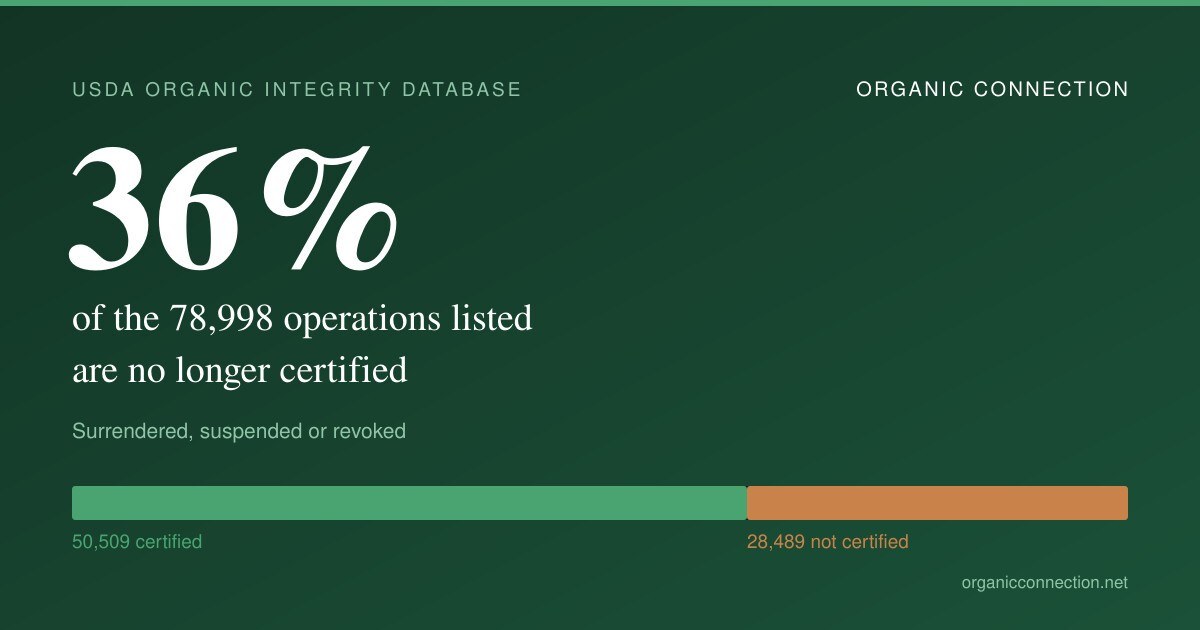
A review of the USDA's public Organic INTEGRITY Database has found that 28,489 of 78,998 listed operations are no longer certified, representing roughly 36 percent of all entries. The analysis, conducted by product research site Organic Connection, underscores a widespread misunderstanding among shoppers who rely on the database to confirm organic claims. The database, maintained by the Agricultural Marketing Service, is the official record used by buyers, certifiers, and regulators to verify that a farm or handler is authorized to sell products as organic.
According to Organic Connection, of the 78,998 operations recorded, only 50,509 are listed as certified. The remaining 28,489 carry a status of surrendered, suspended, or revoked. "A shopper who has been told to look a brand up in the USDA database usually stops at whether the name appears," said James Hardy, editor of Organic Connection. "Appearing is not the answer. More than a third of what is in there is a record of an operation that used to be certified, and the status field is the part that matters."
The second major finding concerns absence rather than status. When Organic Connection checked brands from its own published product guides against the database, food and garden companies frequently resolved to a matching legal entity, while beauty, personal care, and pet grooming brands largely did not. The reason is structural: the USDA's National Organic Program certifies agricultural operations under four scopes—crops, livestock, handling, and wild crops. A cosmetics company that formulates a product using certified organic ingredients purchased from certified suppliers is not itself required to be a certified operation, and thus has no entry of its own.
"The absence of a shampoo brand from the USDA database is not evidence that its organic claim is false," Hardy said. "It usually means the certification sits with the farm that grew the ingredient and the handler that processed it, several steps upstream from the bottle. Treating absence as proof of fraud would be as wrong as treating presence as proof of quality."
For personal care products, the standards that apply to a finished formulation are cosmetic-specific rather than agricultural. COSMOS and Ecocert set minimum percentages of organic content within a formulation and restrict permitted synthetics and processing chemistry. These are the certifications most likely to appear on a certified organic moisturizer or cleanser. The distinction matters because U.S. cosmetic labeling is otherwise permissive. Terms including natural, clean, and hypoallergenic carry no regulatory definition, and the U.S. Food and Drug Administration notes that it does not have a definition for the term "natural" in cosmetics.
Pet grooming products occupy a further gap. They are not cosmetics under the Federal Food, Drug, and Cosmetic Act, which defines a cosmetic by application to the human body, and they become drugs only when a label makes a therapeutic claim such as treating mange or killing fleas. That leaves descriptive language on a bottle of pet shampoo facing less scrutiny than the same wording on a human product. USDA organic certification remains available to these products because it is an agricultural standard rather than a cosmetic one, which is why the small number of pet grooming products that do carry the seal are unusual.
The analysis sets out three practical checks for shoppers. First, read the status field rather than the presence of a name, since a surrendered or suspended operation is listed alongside a certified one. Second, expect beauty and pet brands to be absent and look instead for a named cosmetic standard on the packaging. Third, treat "made with organic ingredients" as a materially weaker claim than "certified organic," since the former requires only that some unstated proportion of the formulation is certified. These findings highlight the importance of understanding the limitations of the USDA database and the alternative certification systems that govern non-food organic products.