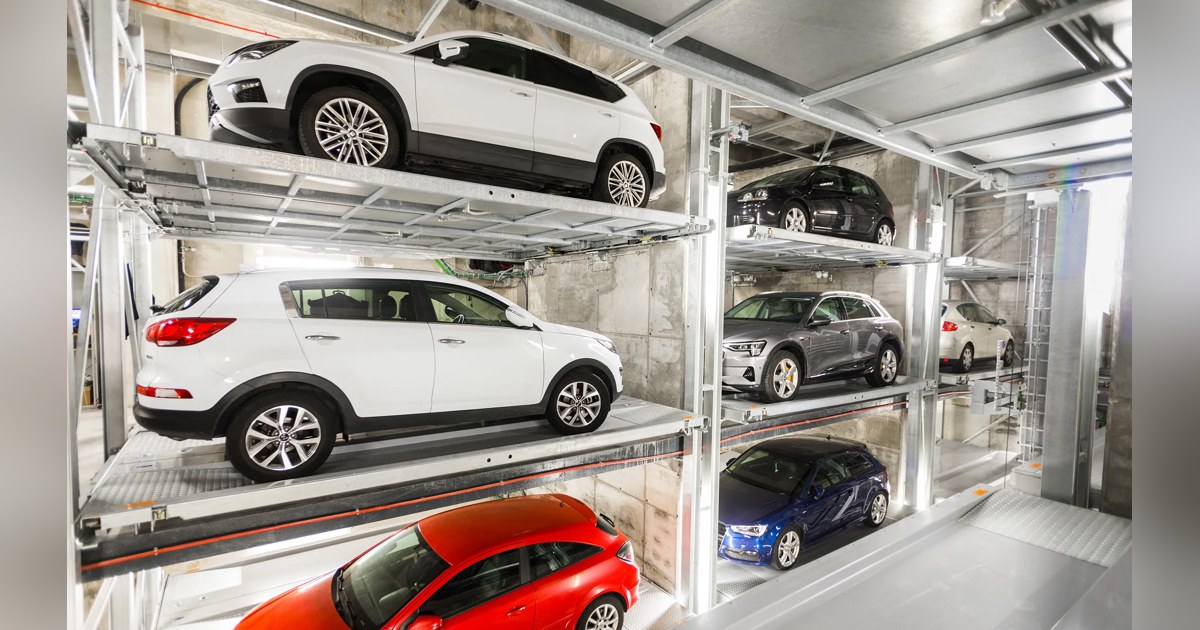
Developers weighing parking options on tight sites should not assume that tariffs on European imports make mechanical parking less competitive, according to Christopher Tiessen, President and CEO of KLAUS Multiparking America. Tiessen argues that the math still favors mechanical systems because they recover space that conventional ramp structures cannot, and that recovered space outweighs any single line item on a quote, including tariffs.
Since July 2026, imports from the European Union have carried a 15% all-inclusive tariff ceiling under the new EU-US trade framework, with steel and aluminum content continuing to carry a separate 50% Section 232 duty on top of that ceiling. Tiessen notes that this cuts both ways: a conventional cast-in-place or precast ramp structure relies heavily on structural steel and was already the more expensive path per space before any tariff entered the conversation, because it requires far more built area for ramps, drive aisles, and circulation that mechanical systems do not need.
KLAUS Multiparking America, the U.S. subsidiary of the German manufacturer, assembles its systems domestically from modular components manufactured in Germany, so its equipment carries tariff exposure too. But according to Tiessen, that exposure does not change which option comes out ahead; it just means the comparison needs to be run honestly on both sides. “If a developer’s instinct is to avoid our line item by defaulting to a conventional ramp structure instead, that’s the wrong read on the numbers,” Tiessen says. “They’re not avoiding tariff exposure by doing that; they’re buying tariff-exposed steel in far greater volume, on a structure that already costs several times more per space once you account for the additional floor area. The tariff doesn’t flip the comparison. It’s a relatively small variable sitting on top of a conclusion that was already pretty clear.”
Conventional structured parking runs at a national median of roughly $33,300 per space, and that figure already reflects steel, concrete, and labor costs that have been climbing independent of trade policy. Mechanical parking’s advantage was never that it was immune to cost pressure; it was that it turns space that would otherwise go to ramps and oversized footprints into buildable or leasable area. Adding a tariff line to one side of that comparison does not erase the structural advantage on the other.
“Even with a tariff added to our side of the ledger, the math a developer runs still starts with how many units or how much additional program they can fit on a constrained site,” Tiessen notes. “That’s the number that moves a pro forma. A percentage on the equipment cost is real, but it’s one variable sitting inside a much bigger calculation, and it’s one we can help a developer plan for early rather than discover late.”
Tiessen, who brings both German engineering roots and American development experience to how he frames these conversations, argues that planning early, not avoiding tariffs altogether—which isn’t really an option for anyone sourcing specialized building systems—is the actual takeaway for architects and developers right now. KLAUS’s approach has been to quote tariff exposure as a transparent, itemized cost rather than folding it into an opaque total, so developers can run the comparison with real numbers instead of assumptions. “We’d rather a developer see exactly what’s driving a number than wonder about it,” Tiessen says. “Trade policy is going to keep evolving. Our job is to make sure that doesn’t change the answer to the question that actually matters: what gets the most usable space out of the site they have.”