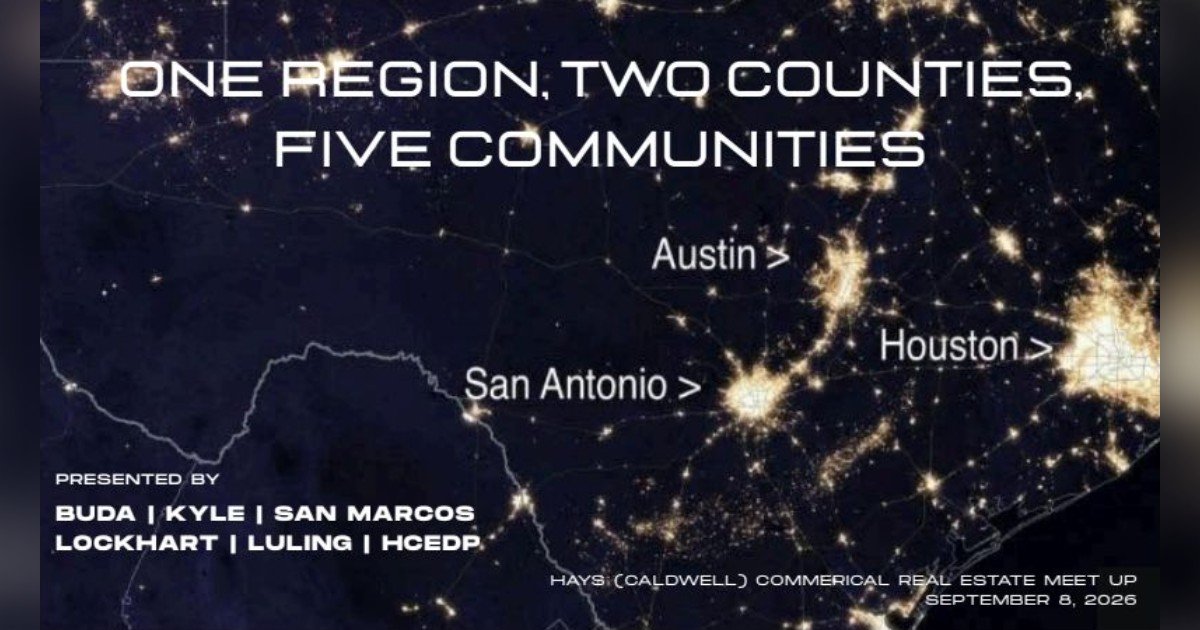
In an unprecedented display of regional unity, six economic development leaders from Hays and Caldwell Counties convened before a capacity crowd at Buda City Hall on Tuesday, marking the largest gathering in the four-year history of the Hays (Caldwell) Commercial Real Estate Meetup. The event, hosted by the Buda Economic Development Corporation, drew more than 140 developers, brokers, investors, city officials, and service providers, underscoring a growing appetite for coordinated economic strategy across the Austin-San Antonio corridor.
The panel featured Jennifer L. Storm of the Buda EDC; Victoria Vargas of the City of Kyle; Helen Ramirez, AICP, of the City of San Marcos; Holly Malish, CEcD, of the Lockhart EDC; Ari Arias of the Luling EDC; and Mike Kamerlander, CEcD, of the Hays Caldwell Economic Development Partnership. Their joint appearance, organized under the theme "one region, two counties, five communities," highlighted a deliberate shift from parochial competition to collaborative growth planning through 2027.
Organizer Tim Dowling of The Roundabout in Buda noted the significance of the turnout. "We've run this meetup for four years, and we've never seen a response like this," Dowling said. "Getting six regional economic development leaders in the same room, all sharing their real priorities for where their communities are headed, is a rare opportunity." The sold-out session suggests that market participants are increasingly seeking intelligence directly from decision-makers as investment decisions hinge on regional dynamics rather than isolated municipal incentives.
Storm framed Buda as offering "Austin access without Austin friction," citing roughly three million square feet of Class A industrial space available or under construction, a highly educated talent base, and the planned early 2027 grand opening of The Depot on Main, a revitalized historic train depot designed as a launchpad for makers and retail startups. Her remarks positioned Buda as a key node in a corridor that blends urban amenities with smaller-market responsiveness.
Each community brought distinct strengths to the table. Kyle pointed to healthcare expansion, including St. David's new emergency center and ACC's growing health sciences presence, plus new Class A industrial inventory at Kyle Commerce Center. San Marcos described itself as the region's education and innovation powerhouse, anchored by Texas State University, STAR Park, the regional airport, and an advancing aerospace and defense ecosystem. Lockhart celebrated Hill Country Foodworks' expansion from 10,000 to 62,000 square feet and new downtown redevelopment frameworks. Luling, the gateway to I-10, spotlighted X-Bow's production campus and a widening aerospace and retail footprint.
The implications for the region are substantial. Leaders stressed that companies gain choice across five distinct communities while still benefiting from shared infrastructure, permitting support, and a regional labor market of more than 2.7 million workers within a 60-minute drive. Kamerlander and colleagues framed the Austin-San Antonio Innovation Corridor as Central Texas' next defining opportunity, with aerospace and dual-use defense technology accelerating alongside advanced manufacturing, retail, and hospitality. This coordinated approach could accelerate site selection decisions, reduce duplication of efforts, and present a unified front to national and international businesses considering relocation or expansion.
Workforce readiness, regional job fairs, career and technical education, and business retention emerged as shared priorities. Small business support to microloan partnerships was celebrated as essential to the quality of place that draws and keeps talent. Leaders repeatedly returned to partnership over competition, describing economic development as job creation, honest deal-making, and "dot connecting," not blank checks. The tone was confident and collegial: leaders, backed by regional partnership, presenting not as rivals but as a coordinated front.
The Hays (Caldwell) Commercial Real Estate Meetup meets the second Tuesday of each month and serves professionals shaping commercial real estate and economic growth across Hays County, Caldwell County, and the Texas Innovation Corridor. As the region prepares for continued expansion, the unified stance of these six leaders may well become a model for other corridors seeking to balance local identity with regional competitiveness.