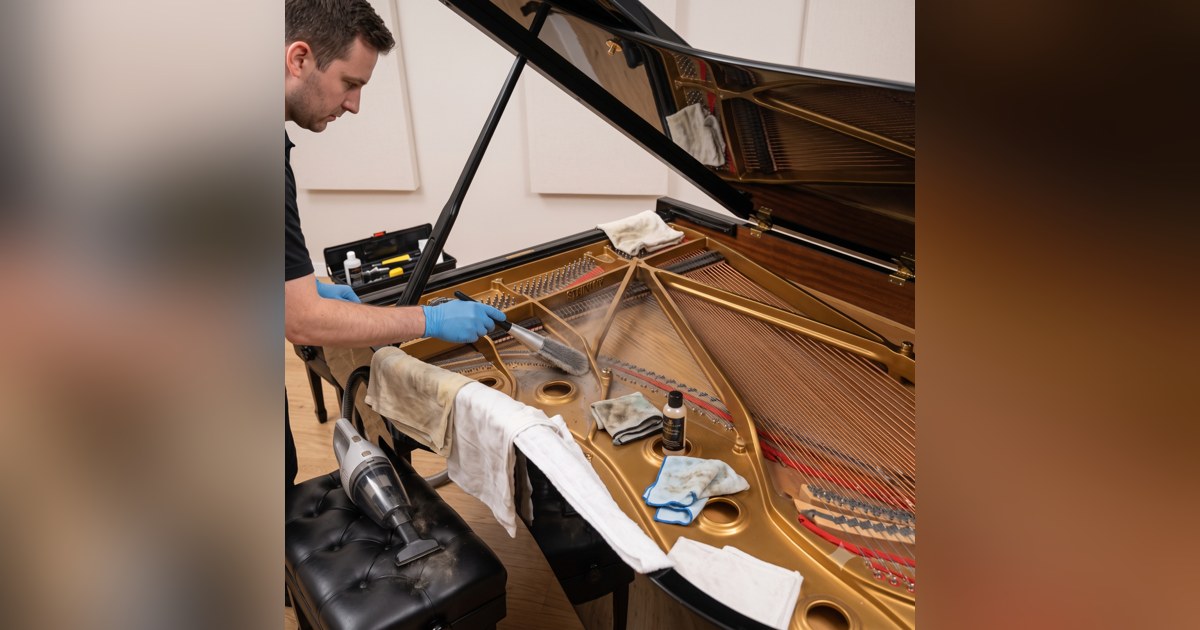
Dust does not stay on the lid. It settles on the soundboard under the strings, works down into the key bed, and packs into the felt and wood of the action, where a dust rag never reaches. Moore Piano, headquartered in Fort Wayne, has outlined what a professional Piano Cleaning actually covers, so owners across Northeast Indiana and Northwest Ohio know what they are paying for before they schedule.
Most people picture furniture polish and a clean set of keys, but that is the part of the job that takes the least time and makes the least difference to how the piano plays. The real work happens inside the instrument, where dust builds into a gray film across the soundboard, collects on the bottom board behind the lower panel, and packs into the action—a mechanism of thousands of moving parts. Dust is abrasive; when it gets into the cloth bushings that surround each metal pin, friction increases, and keys begin to feel sluggish, uneven, or slow to repeat.
Regional conditions shape what a technician finds. Humid summers and dry winters move moisture in and out of wood and felt all year. Homes with pets add hair that wraps around action parts; wood-heated homes add fine ash. Pianos stored in barns, garages, or church basements often come with rodent evidence and chewed felt. School pianos, like those Moore Piano services for Fort Wayne Community Schools and East Allen County Schools, face chalk dust, cleaning spray overspray, and constant handling. Key cleaning itself requires identifying whether keys are ivory or plastic, since ivory is porous and reacts badly to ammonia, bleach, and alcohol. Plastic tolerates more, but the sides and fronts of keys hold dark bands of oil and grime that require one-by-one attention.
Reaching the soundboard, plate, and strings is equally involved. In a grand, technicians use thin flexible tools to work between roughly 230 high-tension strings. In an upright, the bottom board underneath the strings is usually the dirtiest single surface. This is also when problems surface: a cracked bridge, corroded strings, moth damage in hammer felt, or a loose flange that would never be found from the outside. For owners who want a fuller breakdown of the piano cleaning process, Moore Piano provides detailed information before they decide how far to go.
The implications for piano owners are significant. A piano that has gone years without interior cleaning is the normal case, not the exception, and the accumulated debris affects touch, tone, and ultimately the instrument's lifespan. Cleaning is frequently paired with tuning in the same visit, since moving the action and removing keys can change how the instrument responds. Moore Piano serves Fort Wayne and surrounding counties in Northeast Indiana and communities across Northwest Ohio, offering tuning, repair, restoration, and cleaning for acoustic, digital, and player instruments. Service details, customer reviews, and current availability are listed with Moore Piano in Fort Wayne, and appointments generally open within one to seven days.
Ron Moore, a master piano technician with more than 14 years in the trade, tunes and maintains pianos for the Fort Wayne Philharmonic, the Embassy Theatre, The Clyde Theatre, and Honeywell Arts & Entertainment. The same inspection and methods apply whether the instrument is a concert grand on the Embassy stage or a 1950s console in a Decatur farmhouse. For an instrument that sits in one spot for decades with an opening at the front, professional interior cleaning is not cosmetic—it is maintenance that protects playability and value.