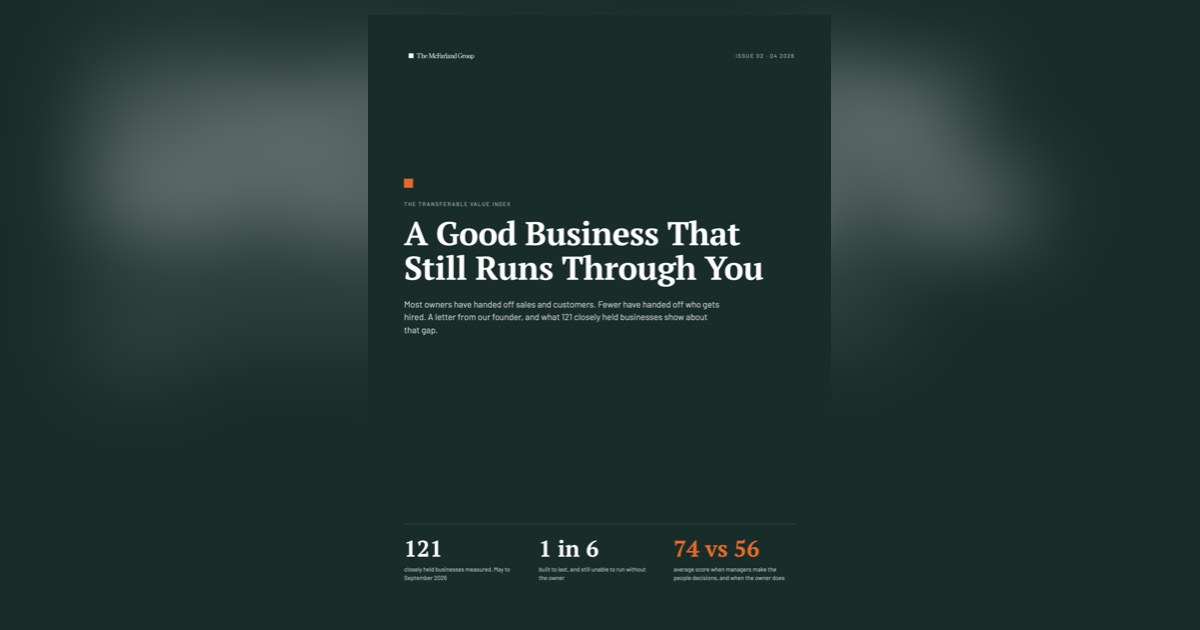
The McFarland Group has released the second issue of its Transferable Value Index, a quarterly measure of how closely held businesses hold up without their owners. Based on 121 assessments submitted between May and September 2026, the index scores businesses on two dimensions: Business Durability and Owner Independence. The findings reveal that 19 of the 121 businesses, or one in six, fall into a category called Owner-Dependent Success, where high durability coexists with low owner independence.
These Owner-Dependent Success businesses score 20.5 out of 30 on durability, close to the top bracket's 22.0, but trail significantly on independence, scoring 14.6 versus 22.8. The correlation between the two dimensions is 0.57, meaning they share only about a third of their variation. This indicates that a business can become much sturdier operationally while its owner remains just as central to its functioning.
The sharpest divide emerges over people decisions. Six in ten owners say their team closes most new business and holds customer relationships, but fewer than half say their managers handle hiring, pay, and terminations for their own teams. Moreover, 22 percent of owners report personal involvement in most people decisions, down to front-line roles. No other question in the index draws such a hands-on response.
This single question tracks closely with overall scores. Where managers make their own teams' people decisions, businesses average 74 out of 100 on the other eleven questions, and none are classified as Owner-Run. Where the owner remains personally involved, the average drops to 56, and nearly half are Owner-Run. Among Owner-Dependent Success businesses, 68 percent of owners remain personally involved in people decisions, compared with just 10 percent in the top bracket.
Byron McFarland, founder of The McFarland Group, explains the paradox: "Building a durable business rewards involvement: your judgment, your relationships, your standards, stamped on everything. Building an independent one requires the opposite: removing your judgment, your relationships, your standards from the machinery, one piece at a time, on purpose. Nobody does the second by accident. You have to mean it."
The implications for ownership transitions are significant. In due diligence, buyers ask who handles terminations because the answer reveals where responsibility truly sits. If the owner still makes that call, the leadership team has never made the hardest decision in the building. The index recommends that most owners start by delegating people decisions to the managers who will own them after the transition.
The full issue, including McFarland's letter, a map of all 121 businesses, and a question-by-question breakdown, is available for free download without a form at The McFarland Group's blog. The Transferable Value Index assessment is also free at transferablevalueindex.com and takes about four minutes, returning scores on both dimensions and a placement in one of four categories.
The findings underscore that owner independence, particularly in people decisions, is a critical factor for business transferability. As the index shows, durability alone does not guarantee a smooth transition; owners must deliberately step back from key decisions to build a business that can thrive without them.