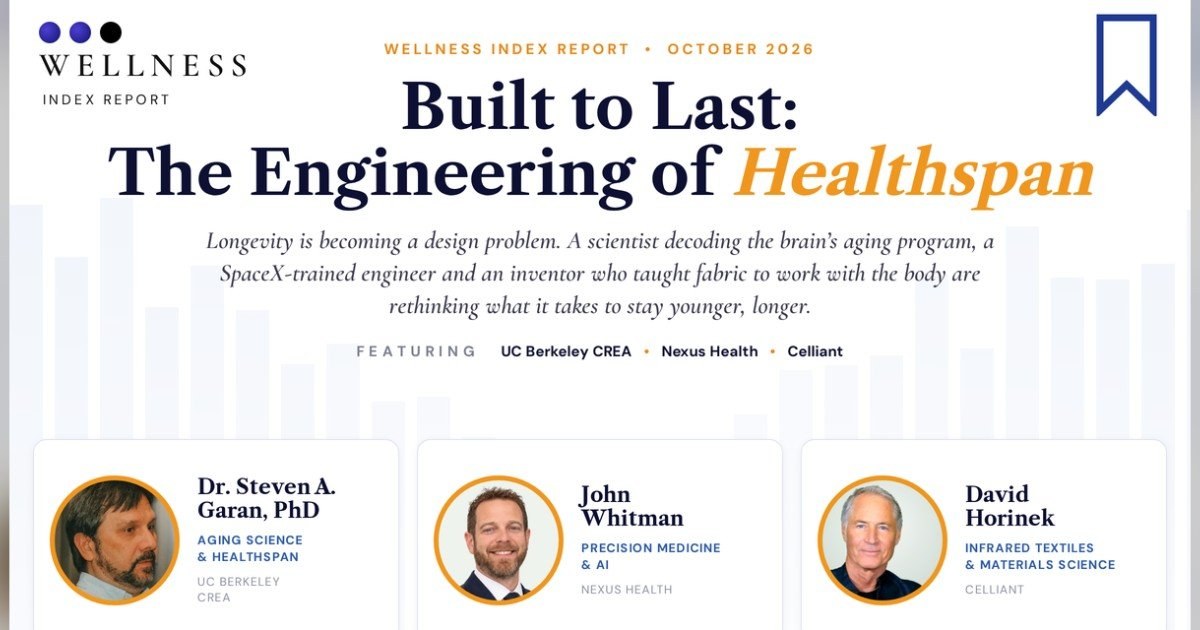
The October 2026 issue of the Wellness Index Report, titled "Built to Last: The Engineering of Healthspan," marks a notable pivot in how the longevity sector frames its mission. Rather than promoting the pursuit of extra years as a matter of luck or lifestyle guesswork, the publication from Wellness Eternal argues that the aging process is increasingly being treated as a design challenge with identifiable inputs, measurable outputs and engineering disciplines attached. That distinction matters because it moves the conversation from aspiration to accountability, giving consumers and clinicians a framework for evaluating claims in a market crowded with supplements and devices.
The report profiles three guests from The Wellness Index Report Podcast, each attacking a different layer of the problem. Dr. Steven A. Garan focuses on brain-driven aging, advancing the idea that aging is not a uniform decline but a program governed by the brain that accelerates at specific life stages, including midlife and menopause. The timing is pointed: the issue coincides with World Menopause Day, drawing attention to a phase of life that has historically received far less research funding and clinical focus than its impact warrants.
John Whitman and Nexus Health represent the data layer, describing clinician-reviewed, privacy-focused precision health AI that connects genetics, lab results and patient history and returns explainable findings under a clinician's control. That emphasis on explainability and oversight is significant, because the credibility of AI in health settings depends on whether practitioners and patients can understand how conclusions are reached rather than accepting a black box. David Horinek's work with Celliant infrared textile technology illustrates a third layer: embedding wellness into ordinary products such as sleepwear, bedding and recovery apparel, where benefits accrue without requiring new daily routines.
Together the three profiles outline trends the publication believes will shape healthspan in the near term. The first is a rethinking of aging as a brain-governed process with predictable inflection points, which could reshape when and how interventions are timed. The second is the maturation of AI that supports rather than replaces clinicians, a distinction likely to determine adoption in regulated medical environments. The third is the quiet integration of therapeutic function into consumer goods, a shift that raises fresh questions about how such products are validated and marketed.
For readers following the biohacking and longevity space, the issue functions as a useful signal of where investment and expertise are concentrating. The full announcement, including downloadable images and bios, is available through the click here link, while ongoing coverage from the monthly publication can be found at the Wellness Index Report. The broader implication is that healthspan is moving from a hopeful slogan toward an engineering discipline, with all the standards, scrutiny and evidence demands that entails.