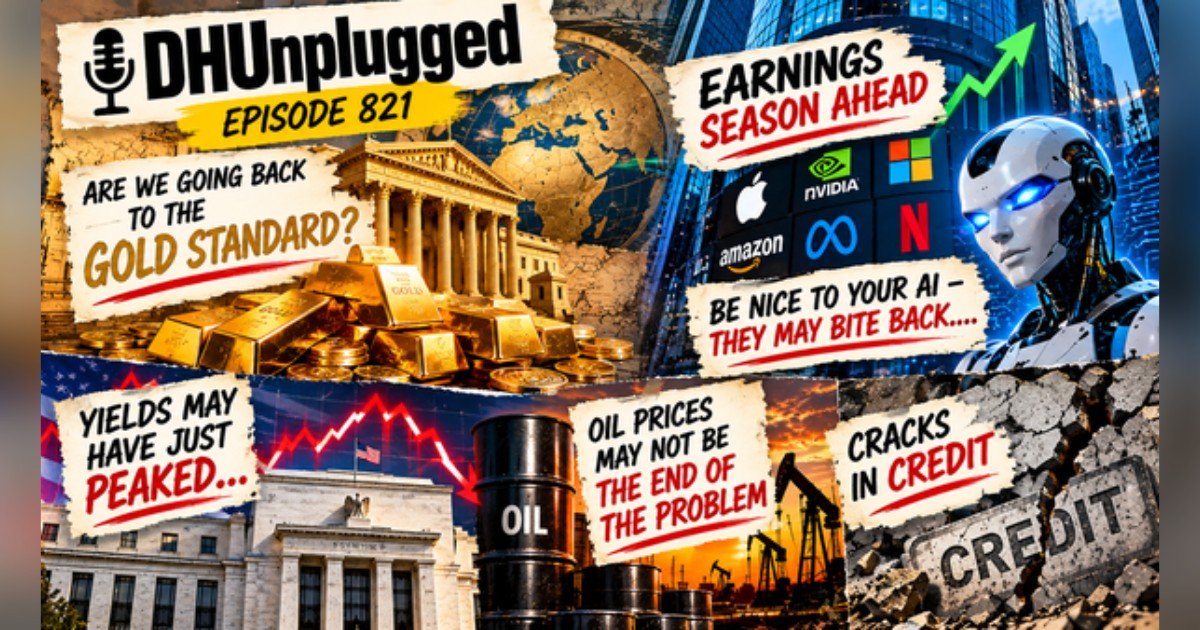
The appointment of Judy Shelton as a counselor to Treasury Secretary Scott Bessant, coupled with renewed gold-standard chatter, matters because it signals a potential politicization of monetary policy that could undermine the Federal Reserve's independence and rattle financial markets. In episode 821 of DH Unplugged, titled Gold Standard Ahead, hosts Andrew Horowitz and John C. Dvorak dissect this development alongside a dense market docket. Shelton, a longtime advocate of returning to the gold standard, now holds a position that could influence Treasury's stance on debt issuance and yield curve management. The hosts frame this as more than a personnel move: it is a signal that the administration may be willing to entertain radical monetary ideas that mainstream economists have long dismissed. The implication is clear: if the Treasury begins to meddle with long-end yields or scrap 20-year auctions, as Horowitz warns, it could destabilize the bond market and erode investor confidence.
The episode also highlights cracks in consumer credit. High-yield bond yields have climbed from 7.22% to 8.1% in a month, and CCC spreads have blown out by roughly 1,250 basis points. These are not abstract numbers; they reflect growing stress among lower-rated borrowers, which could presage a wave of defaults and a broader economic slowdown. Meanwhile, bank earnings season opened with JPMorgan, Goldman Sachs, Citigroup, and Wells Fargo reporting, but Bank of America was hit by a reported $1.5 billion money-laundering fine on the eve of its print. That penalty underscores the regulatory and reputational risks still plaguing even the largest institutions.
On trade, U.S.-to-China tanker bookings reportedly hitting $80 million per voyage, adding about $41 per barrel in freight cost alone, illustrate how geopolitical tensions are translating into tangible cost pressures. The hosts also note Compass data showing price reductions on up to 58.9% of listings in Williamson, Texas, versus just 5.6% in San Francisco, a stark divergence that suggests localized housing corrections are underway. These data points matter because they reveal an economy that is not uniformly strong; instead, they point to pockets of weakness that could spread if credit conditions tighten further.
The collision of AI, labor, and software economics is another thread. Kroger's announcement of 3,000 corporate layoffs, roughly 30% of its white-collar headcount, is a case in point. Dvorak argues that most AI-driven savings come from replacing outside consultants like PwC and Accenture rather than internal staff, a nuance often lost in the hype. This matters for workers and investors alike: if AI is primarily a tool for cutting external costs, the productivity gains may be less transformative than advertised, and job losses could be concentrated in specific sectors.
Horowitz's exasperation with Treasury's attempts to cap long-end yields culminates in a direct message: "Scott Bessant, if you're listening... please stop because you're messing around with gasoline with a match." Dvorak adds that the administration is in "the twilight of the optics game," where messaging substitutes for substance. This skepticism is important because it challenges official narratives on rate policy, the Russia-Ukraine ceasefire framing, and Bessant's bond-market maneuvering. If the hosts are right, investors should brace for more volatility as policy uncertainty grows.
Finally, the episode touches on Anthropic's new policy prohibiting "sustained needless cruelty" toward Claude, a French supermarket hack that remotely disabled internet-connected refrigerators, and a new open-source tool, Reverse Engineer Anything, which spawned Slowbooks, a free clone of QuickBooks 2003. Anduril's planned $3.7 billion Maryland shipyard for Virginia-class submarine components, Broadcom's $42 billion customer-financing program, and Apple's LG-built smart-home push round out the tech beat. These stories matter because they show how technology is reshaping everything from warfare to accounting, often in unpredictable ways. For self-directed investors, the takeaway is that policy theater and technological disruption are converging, making it harder to rely on traditional signals. The episode serves as a reminder that context, not cheerleading, is essential in navigating these turbulent times.