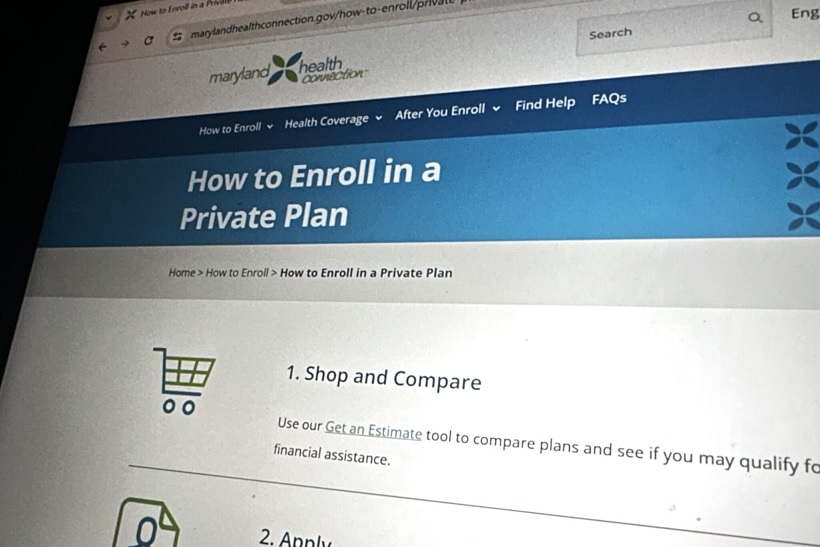
As Marylanders start to navigate the open enrollment period for health insurance, state officials are pointing out that higher costs aren’t the only changes that could trip people up.
“We encourage everybody to come back in and look at their plan, make sure the plan makes sense for your needs, for your family’s need,” Michele Eberle, executive director of the Maryland Health Benefit Exchange, said in a webinar Friday on the changes on open enrollment this year.
The Marketplace Integrity Rule out of the Centers for Medicare and Medicaid Services and the federal budget reconciliation bill, often referred to as the “One Big Beautiful Bill Act,” is bringing massive changes to health care. But Eberle said that the expected expiration of popular federal tax credits for health care plans at the end of the year creates the “triple whammy” of factors that will jack up costs for some 300,000 Marylanders, which could lead to tough choices for some, including going without insurance.
While those federal policies bring in changes for the 2026 insurance year, not all will take effect right away. Here’s a run-down of what Marylanders can expect this open enrollment period, which runs from Nov. 1 through Dec. 31, and in the future.
Maryland Health Secretary Meena Seshamani said that raised premiums will “continue to be a problem if Congress does not take decisive action to extend tax credits.” The enhanced federal tax credit was created in 2021 to help more people afford health insurance during the height of the COVID-19 pandemic and are set to expire at the end of the year. Democrats, including Maryland’s congressional delegation, have refused to vote a stopgap spending bill until Republicans agree to address the tax credits.
For this year’s rate increase, insurance carriers asked for an average increase of 17.1%, accounting for the anticipated loss in enrollment if the tax credits expire. The Maryland Insurance Agency ultimately approved a 13.4% average rate increase, which applies to everyone on the health benefit exchange. Some of the lower-income marketplace purchasers may be spared from the greatest premium hike this year. The General Assembly approved funding this past session that would partially replace the soon-to-expire federal tax credits for the upcoming year. For the 2026 enrollment year, those state subsidies will be able to replace the extended tax credit for those under 200% of the federal poverty level. For those between 201% and up to 400%, the state subsidy will replace 50% of the value of the tax credits. But the state’s fraught fiscal outlook means those state subsidies could be temporary, state officials say.
Some Marylanders will have a harder time accessing health care because of their immigration status. The Marketplace Integrity Rule revoked a Biden-era decision that classified immigrants covered by the Deferred Action for Childhood Arrivals program, or DACA, as “lawfully present” individuals. Being lawfully present allowed DACA recipients access to the Maryland Health Benefit Exchange to shop for plans. The last open enrollment period was the first time DACA recipients could use Maryland’s insurance marketplace. Without the classification, DACA recipients are again barred from the health insurance marketplace. That change took effect in August, affecting about 300 DACA recipients. Eberle also said that around 18,000 lawfully present immigrants with incomes lower than 100% of the federal poverty level will no longer be able to use tax credits that kept their health care costs down.
While much of the conversation around open enrollment involves increasing prices, Eberle noted that the state’s subsidy targeted for young adults is still in play, meaning that people aged 18-37 may still qualify for financial help that brings their monthly premiums down. In addition, some federal changes won’t take effect this year, meaning that Marylanders and state officials have some time to prepare for new hurdles in access to health care. For example, Marylanders who don’t commit to a health care plan by the end of this year will still have a few weeks in January to determine what insurance best works for them. That’s because this is the last year of an extended open enrollment window before federal policy shortens it. Starting in the 2026 open enrollment year, people will have from Nov. 1 through Dec. 31 to commit to a new plan. “That’s a big change,” Eberle said. “It’s just another barrier to coverage.”
She also said that another change coming down the line is the end of auto enrollment in coverage. In 2028, a new federal policy means that people will have to manually indicate that they want to continue coverage each year. Eberle said that without auto enrollment, “if people are not aware of that and they let their coverage lapse, then they may not be eligible until the next year to get health coverage.” While Maryland still has auto enrollment for the next two years, Eberle still urges everyone to take a look at their coverage and see if their plans are still the best for their household, especially considering a hike in premium costs.