Solid American hardwoods have served as the nation’s flooring gold standard since its founding, and their enduring appeal lies in a combination of durability, practicality, and environmental performance that few other materials can match. Oak, walnut, maple, and ash can be sanded and refinished for decades, outlasting heavy foot traffic, pets, and changing design trends while developing a richer character over time. They are available in multiple widths, grades, and finishes, and they are easy to install, making them a reliable choice for architects and builders.
“American hardwoods are grown, harvested, and milled right here, giving architects and builders a reliable, high-quality supply,” said Ian Faight of the American Hardwood Information Center. “Nothing rivals hardwood’s warmth and natural variation, and as a low-emission, renewable resource, it supports healthier interiors and everyday well-being.” That domestic supply chain matters not only for quality control but also for reducing the carbon footprint associated with transporting building materials, a point that resonates as green-building standards tighten.
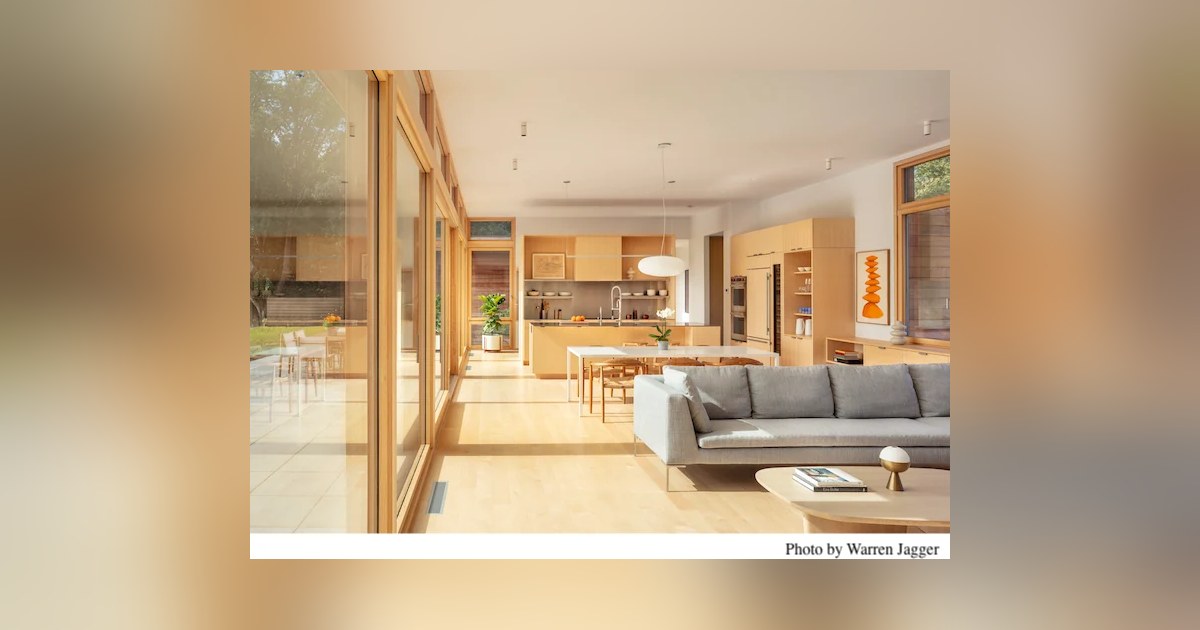
The material’s design flexibility is on display in projects across the Northeast. In East Greenwich, Rhode Island, a low-slung modern home by Estes Twombly + Titrington Architects uses 5-inch-wide hard white maple boards from Vermont Plank Flooring, finished with the company’s Killington Peak stain to draw out warm, golden-brown tones. Clear-finished maple window frames, trim, and cabinetry continue the palette, grounding a light-filled, sustainably minded interior. In a new shingle-style house in Charlestown, Rhode Island, by Arnold Design Group, a custom spiral stair features select-grade ash treads and a landing of 7-inch-wide boards in the same wood, some laid in a herringbone pattern with walnut accent borders. A clear, low-sheen Craftsbury finish plays up ash’s naturally pale, subtly striped grain.
Durability and indoor-air quality are recurring themes. Architect Stephanie Horowitz of ZeroEnergy Design specified old-growth white oak, quartersawn for extra stability and a distinctive ray-fleck grain, in a Wellesley, Massachusetts, house built to rigorous green-building standards. The flooring is left uncovered by rugs or carpet, which Horowitz avoids as sources of dust and allergens. In a 19th-century Boston townhouse renovated by Stern McCafferty Architecture + Interiors, roughly 4,000 square feet of select-grade walnut from Vermont Plank Flooring runs throughout, milled in 6-inch planks and finished on-site with a water-based, satin-sheen treatment. The wood honors the home’s history while giving the interior a cleaner, contemporary feel.
Hardwood’s practicality extends to moisture-prone spaces when the right species is chosen. In a whole-house renovation in Dighton, Massachusetts, natural character-grade white oak from Hull Forest Products extends into the primary bathroom, where 8-inch, live-sawn planks run past the vanity toward a freestanding tub and glass shower. White oak’s tight, tyloses-blocked cell structure resists moisture better than many woods, and its density and dimensional stability help it withstand humidity and heavy foot traffic. On a Rockport, Massachusetts, peninsula, Ruhl Studio Architects raised an existing house on concrete pilings to clear flood requirements and capture ocean vistas; red oak in 6-inch boards, finished with a low-sheen Waltham stain, gives the open living space a light, airy foundation for three generations under one roof.
These examples illustrate why hardwood remains a resilient, health-conscious, and domestically sourced flooring option. For homeowners weighing long-term value against short-lived trends, the message is clear: American hardwoods deliver lasting beauty and performance. More information is available through NewsUSA and at www.hardwoodinfo.com.