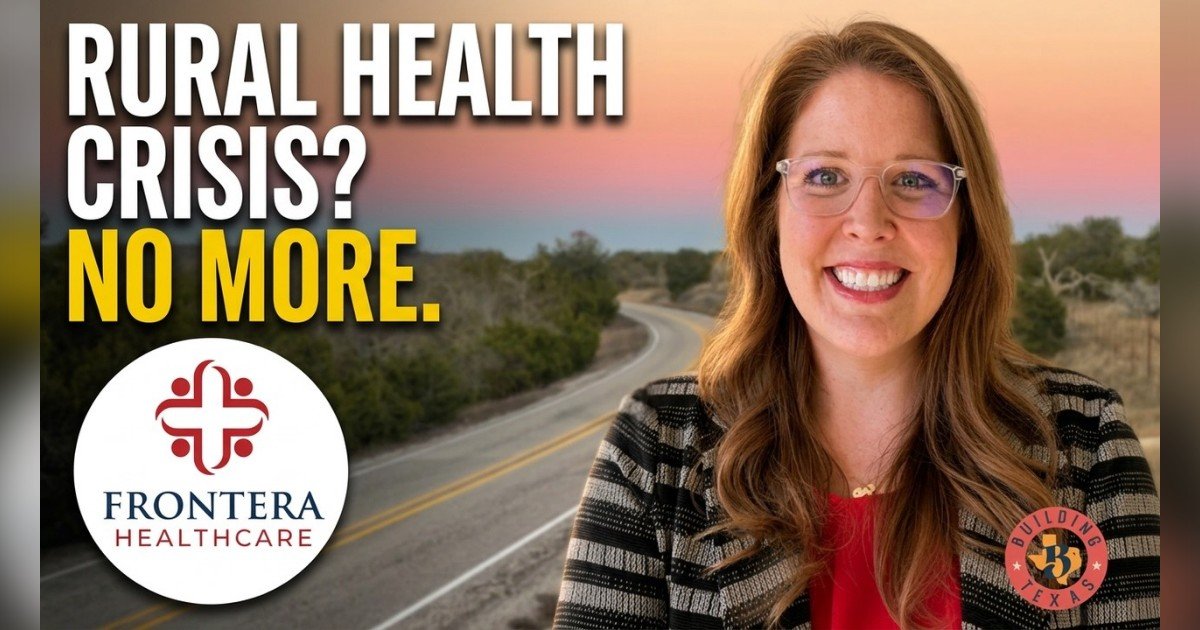
Frontera Healthcare Network, a 501(c)(3) nonprofit community health center, now operates seven locations across five Texas Hill Country communities—three in Fredericksburg, plus Mason, Menard, Junction, and Brady—bringing primary care, behavioral health, psychiatry, pharmacy services, walk-in care, and chronic condition case management to residents who might otherwise travel long distances for basic medical attention. The expansion matters because, as chief strategy officer Allison Leftwich noted during an episode of Rural Texas Has a Healthcare Crisis - This Nonprofit Is Fixing It | Allison Leftwich, "in some of those communities we are the only healthcare providers." That distinction carries significant implications for rural residents, who often face 45-minute drives to reach care, making same-day appointments and same-day prescriptions critical components of a functional local health system.
Frontera's service model addresses several gaps simultaneously. The network offers primary care, behavioral health and psychiatry with a psychiatrist who travels to each location on certain days, and pharmacy services through the federal 340B discounted drug program, with prescriptions sometimes filled while patients are still in the office. Walk-in care is available at the new Fredericksburg clinic, and case management supports patients with chronic conditions through medication assistance and home delivery. These services are designed to reduce the burden on patients who may be underinsured or uninsured, a population Leftwich said the network aims to serve by providing "somebody that will advocate and fight for them."
The personal level of care was illustrated by Leftwich's account of a Menard patient with serious health concerns whose provider called daily to secure a referral. "That provider had the flexibility and knows them on such a personal level that they're able to advocate for them in a different way," she said. She credited CEO Mikki Hand, who grew up in the area and still sees patients two days a week, for setting that tone: "she's caring for people who cared for her as a child." Such continuity is rare in rural health systems and helps build trust among patients who may be skeptical of outside providers.
Workforce development is another pillar of Frontera's strategy. The network has hosted high school interns, welcomed college students for the first time this year, and partners with Texas A&M to bring medical students in for rotations "to ensure that they understand what rural health care looks like." One provider who rotated with Frontera as a student is returning to join the team full time—a tangible outcome that suggests the pipeline approach can help stem rural provider shortages. Leftwich, who has worked with the INCubatoredu program at Fredericksburg ISD and Hill Country Venture Fest, said the goal is to "give them hope that they could find a career in their hometown."
Public awareness remains a challenge. Leftwich admitted she once thought Frontera was pediatrics only, because her own children were patients. "Our goal is to provide affordable health care for everybody in the community," she said, emphasizing that the network serves people regardless of insurance status. For Hill Country families, the presence of a nonprofit like Frontera Healthcare Network means access to care that might otherwise require long drives or go without. The full conversation is available on The Building Texas Show, offering further insight into how rural communities are adapting to healthcare challenges.