As the demand for seamless indoor-outdoor building envelopes grows in luxury residential and commercial developments, architects, contractors, and property owners are increasingly specifying frameless glass garage doors. However, a new technical advisory from bp Glass Garage Doors & Entry Systems highlights significant structural, environmental, and liability risks associated with exterior frameless systems, particularly those relying on adhesive-based construction.
The advisory points out that exterior frameless glass garage doors typically depend on chemical adhesives, double-sided tapes, or caulking to bond heavy glass panels to hidden frames. Over time, thermal expansion, UV exposure, and weathering degrade these chemical bonds, leading to a loss of structural adhesion. This creates a severe safety hazard, including the risk of panel detachment and envelope failure. Rob Reyes, General Manager of bp Glass Garage Doors, stated, "Adhesive-bonded frameless glass doors present a liability for commercial spaces and homeowners alike. In an overhead application, relying on glue to support heavy glass panels over years of operation poses real dangers. Structural integrity must never be sacrificed for temporary visual trends."
Beyond immediate safety concerns, the advisory details several inherent flaws of frameless systems. Aesthetic limitations arise because interior framing must be concealed, often restricting glass to dark gray or mirrored tints; under nighttime lighting, the framework remains visible, defeating the seamless look. More critically, frameless configurations lack verified thermal breaks and independent lab testing, causing failures to meet municipal building codes, energy standards like California Title 24, and NFRC requirements for habitable live/work spaces.
In coastal zones, especially High-Velocity Hurricane Zones (HVHZ) such as Miami-Dade and Broward counties, frameless glass garage doors pose immediate failure risks. Extreme heat, high UV index, humidity, and salt-air exposure accelerate adhesive degradation. Furthermore, unframed, glue-bonded glass panels lack mechanical retention, making them unable to withstand high wind loads or impacts from flying debris during storms. These systems also lack official Florida Product Approval (FPA) and Miami-Dade County Notice of Acceptance (NOA), leading to building audit failures, denied insurance claims, and forced removal by authorities. Reyes emphasized, "Adhesive-bonded frameless glass doors present an unmitigated liability for commercial spaces and homeowners, particularly in hurricane-prone coastal regions like Florida. In high-wind environments, relying on glue to hold heavy glass panels overhead is a severe hazard. True storm protection requires high structural performance systems that are mechanically anchored and impact-tested."
Service and maintenance also become problematic with frameless systems. Proprietary or unverified hardware configurations often require major modifications to replace damaged glass or secure replacement components, leaving property owners without standard serviceability options.
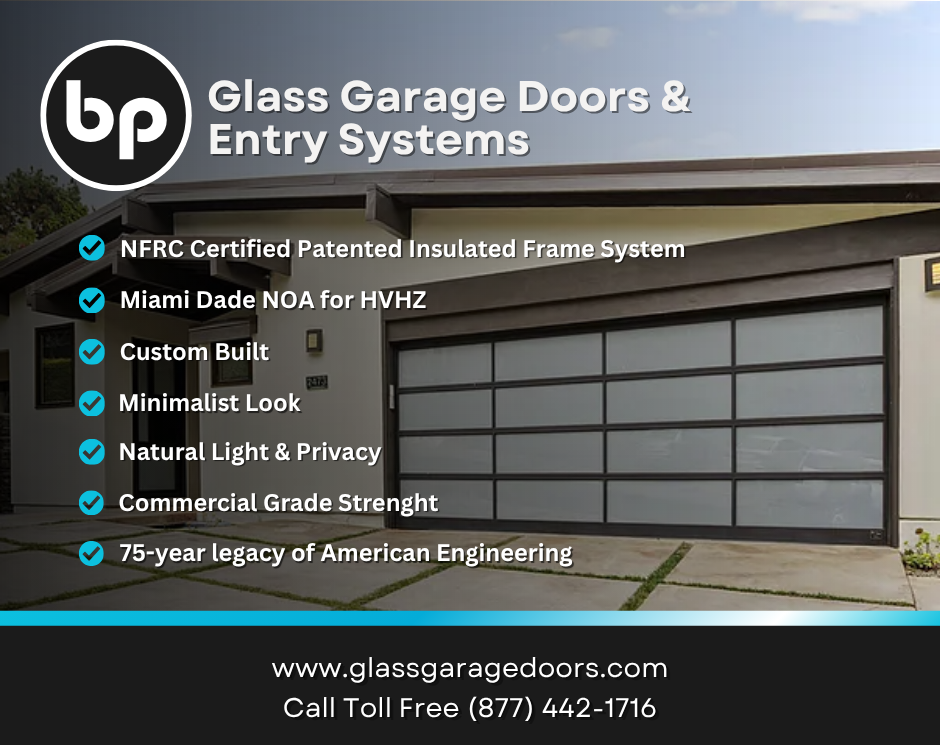
In contrast, bp Glass Garage Doors, with a 75-year manufacturing heritage, offers architectural systems designed to provide the narrowest frames without compromising structural safety. These systems feature more glass and less frame while mechanically securing glass panels within custom fabricated frames. Independently laboratory tested and NFRC certified, bp systems are approved for sensitive live/work environments including commercial restaurants, offices, educational spaces, and luxury residences. The company supports its products with a factory-direct model and warranty.