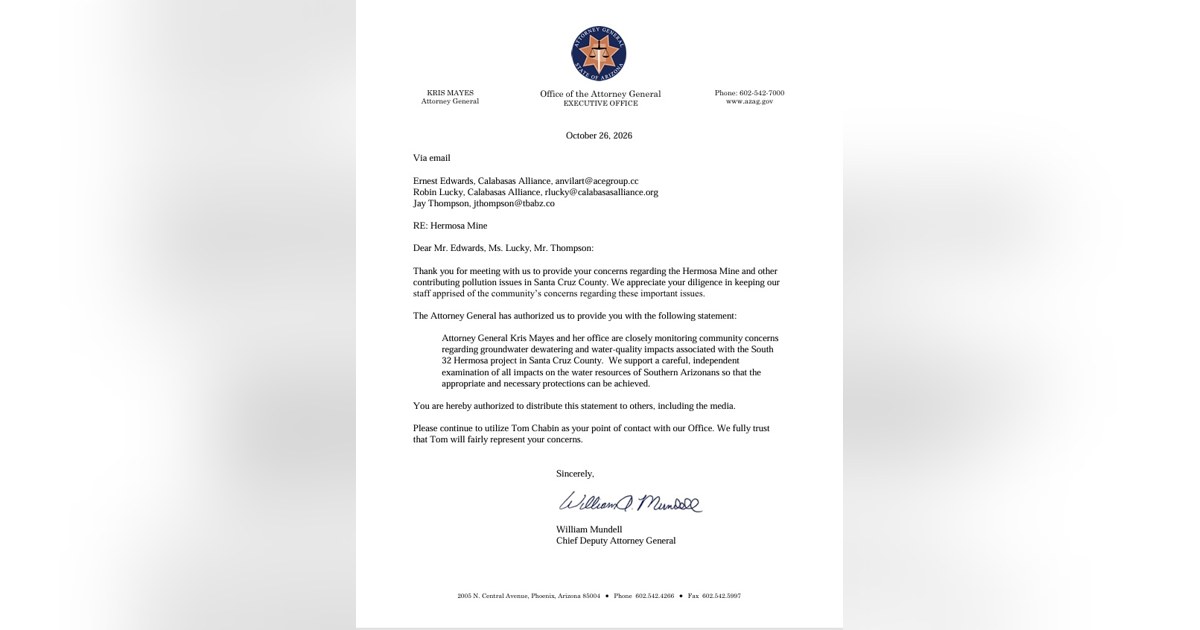
The Office of Arizona Attorney General Kris Mayes has acknowledged community concerns about groundwater dewatering and water-quality impacts tied to the South32 Hermosa Project in Santa Cruz County, lending high-level support to calls for a careful, independent examination of the mine's effects on Southern Arizona's water resources. The statement, released by the Calabasas Alliance, follows the submission of background information, data, and letters from community members, and it signals that state legal authorities are paying close attention to a project that critics say could irreversibly damage local aquifers and surface flows.
The significance of the attorney general's acknowledgment lies in its potential to shift the burden of proof. Community members, technical experts, and researchers have identified gaps in assessing long-term dewatering effects, contaminant pathways, and cumulative impacts on aquifers and surface waters. By supporting an independent examination, the attorney general's office effectively endorses the view that project-sponsored modeling alone is insufficient for decisions about a resource as critical as groundwater. That stance could prompt regulators to require more rigorous, transparent science before permits advance, and it gives residents a stronger platform to demand accountability.
Local leaders warn that high-volume dewatering could create a cone of depression that lowers groundwater levels, threatens wells and surface flows around Patagonia Lake, and necessitates immediate independent hydrologic analysis to secure protections before irreversible damage occurs. For a region already grappling with water scarcity, the prospect of a mining operation drawing down aquifers is not an abstract environmental concern but a direct threat to household wells, agricultural livelihoods, and ecosystems. The attorney general's support for independent review therefore matters because it elevates the issue from a local dispute to a matter of statewide water security.
The Calabasas Alliance, a grassroots organization dedicated to protecting land, air, and water resources in Santa Cruz County, has been central to raising these concerns. The group's work includes participation in air-quality monitoring and water-testing programs, and it has consistently argued for transparent, independently verified science rather than reliance on project-sponsored modeling. For those seeking the full announcement, including downloadable images and bios, the alliance invites readers to click here. More information about the organization is available through the Calabasas Alliance.
Ultimately, the attorney general's statement does not halt the project, but it changes the terms of the debate. It validates the demand for independent hydrologic analysis and puts South32 on notice that its water impacts will face scrutiny beyond its own consultants. If the examination proceeds, it could establish a precedent for how Arizona evaluates large-scale dewatering proposals, ensuring that communities and state authorities have access to unbiased data before irreversible harm occurs.