

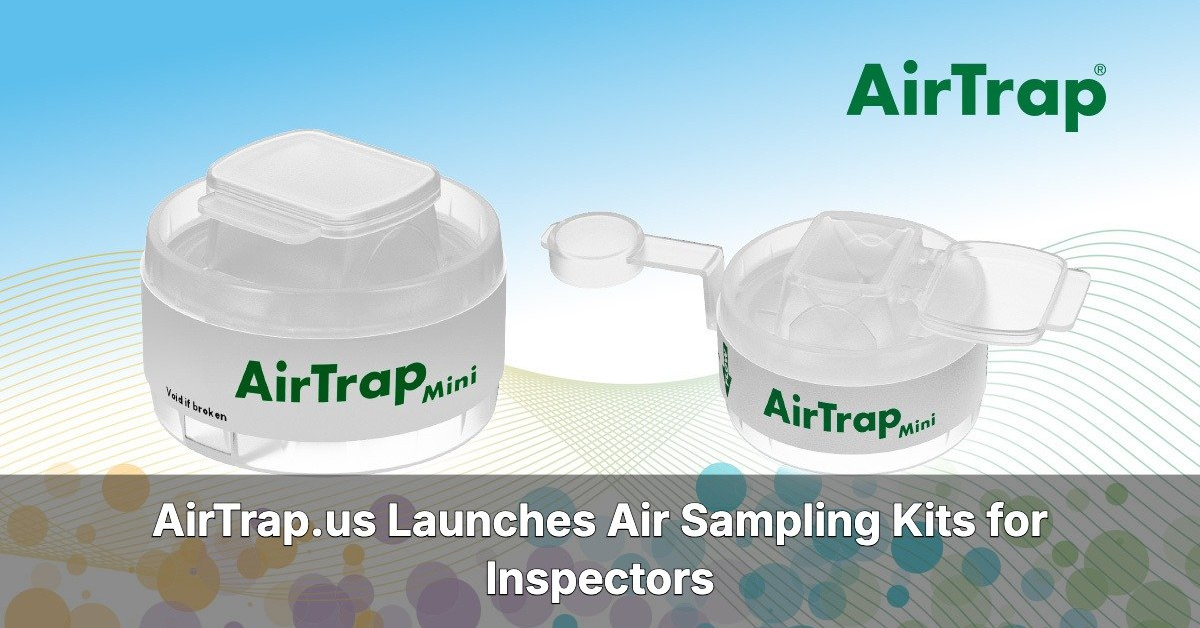
For more than three decades, indoor air quality professionals have relied on spore trap cassettes to collect mold spores and airborne particles for laboratory analysis. The core cassette design, introduced in the mid-1990s, has remained the industry standard. Now, AirTrap introduces a modern alternative that builds on that established methodology while refining key aspects of the cassette's physical design to improve usability in the field, consistency in the laboratory, and material efficiency.
AirTrap air sampling cassettes are now available throughout North America exclusively through AirTrap.us, providing inspectors, laboratories, restoration professionals, schools, and government agencies with an additional option for airborne particle sampling. In 1995, Dan Baxter, director of Research and Development at Aerosol Research Associates, Inc., introduced the Air-O-Cell cassette, which became widely adopted in mold and indoor air quality investigations. AirTrap reflects a collaborative effort to revisit and update the cassette design to better align with current inspection demands, laboratory workflows, and environmental considerations.
AirTrap cassettes are fully compatible with standard air sampling pumps and established laboratory analysis methods, allowing seamless integration into existing inspection procedures without changes to sampling technique. The updated design incorporates several practical refinements: a flip-top cap system engineered to reduce handling errors and minimize sample contamination during transport; approximately 46% less plastic compared to traditional cassette designs; a recyclable housing to support more sustainable testing practices; durable polypropylene construction for field reliability; and a flatter collection surface designed to improve image clarity during laboratory analysis, including digital and AI-assisted microscopy.
These improvements address long-standing issues in the industry. Traditional cassettes often require careful handling to avoid contamination, and their plastic-intensive construction raises environmental concerns. By reducing plastic usage and incorporating recyclable materials, AirTrap offers a more sustainable option without compromising performance. The flatter collection surface enhances the accuracy of laboratory analysis, which is particularly important as AI-assisted microscopy becomes more prevalent.
AirTrap is ideal for indoor air quality assessments, post-remediation verification, real estate inspections, school and university testing programs, cleanroom clearance, and routine environmental monitoring. By modernizing the cassette design while preserving established sampling principles, AirTrap delivers long-overdue improvements that are compatible with existing equipment and familiar workflows. For more information, visit AirTrap.us.
